
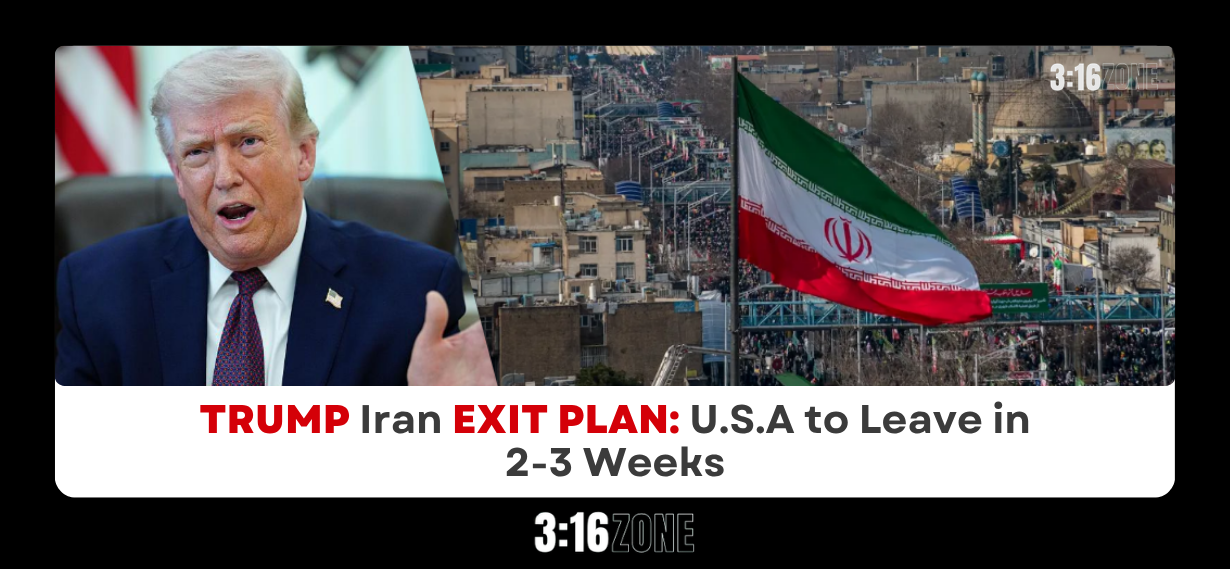
The latest statement from Donald Trump has once again placed the Middle East at the center of global attention. According to Trump, the United States is preparing to withdraw from Iran within the next two to three weeks, a move that could reshape regional dynamics and global markets.
At face value, the decision sounds decisive and strategic. However, when you look deeper, it raises a critical question: is this a calculated military success, or a fast exit from a still-unfolding conflict?
What Did Trump Actually Announce?
Trump made it clear that the U.S. intervention in Iran was never meant to be long-term. Instead, the objective was focused and limited, to weaken Iran’s nuclear capabilities and reduce immediate threats. Now that those targets are reportedly achieved, the administration sees no reason to maintain a prolonged military presence.
This reflects a shift toward a short-duration, high-impact military strategy, rather than traditional long wars that drain both economic and political resources.
A Different Kind of Exit – No Peace Deal Involved
What makes this situation unusual is the absence of any formal agreement between the U.S. and Iran. Historically, conflicts of this scale tend to end with negotiations, treaties, or at least some diplomatic framework that defines the post-war relationship.
In this case, however, the approach appears far more direct — complete the mission and exit without waiting for political closure. While this may speed things up, it also leaves behind uncertainty. Without a structured resolution, the chances of future tensions or misunderstandings remain high.
Ground Reality – Tensions Are Still Active
Despite the announcement, the situation on the ground has not fully stabilized. Military operations are still ongoing in certain areas, and the threat of missile or drone attacks continues to exist. This makes the timing of the withdrawal particularly sensitive.
Leaving during an active phase of conflict is always a complex decision. It can signal confidence, but it can also create a power vacuum if the situation is not fully under control. That’s why analysts are closely watching how both Iran and neighboring countries respond in the coming weeks.
Impact on Oil Prices and the Global Economy
One of the biggest global concerns linked to this conflict is energy security. The region plays a crucial role in global oil supply, especially because of the Strait of Hormuz, a key passage for oil transportation.
Any instability here immediately affects oil prices, which in turn impacts economies worldwide. The ongoing tensions have already caused fluctuations in fuel prices and market uncertainty. Trump has hinted that ending the conflict quickly could help stabilize the situation, potentially easing pressure on global markets.
However, stability depends on how smooth the withdrawal process is. A sudden escalation could easily reverse any positive momentum.
Global Reactions and Strategic Concerns
This decision is not just about the U.S. and Iran — it has broader geopolitical implications. Countries in the Middle East are closely monitoring the situation, as any shift in U.S. presence could alter the balance of power in the region.
At the same time, global allies may begin to question the long-term reliability of U.S. commitments, while rival nations could view this as an opportunity to expand their influence. These factors make the withdrawal more than just a military move; it’s a strategic signal to the entire world.
Strategy or Risk? A Balanced Perspective
There are strong arguments on both sides of this decision. On one hand, a quick exit after achieving objectives can be seen as efficient and cost-effective. It reduces military spending and avoids prolonged involvement in a complex region.
On the other hand, the lack of a long-term plan raises concerns. Without a clear post-conflict framework, there is always a risk that tensions could resurface, potentially leading to another cycle of conflict in the future.
This dual perspective is what makes the situation so important to watch.
Final Thoughts – What Happens Next?
Trump’s announcement sets a very short timeline, which means the coming weeks will be critical. If the withdrawal is executed smoothly and the region remains stable, it could be seen as a modern example of strategic efficiency.
However, if tensions rise again, it may highlight the risks of exiting without a long-term resolution. Either way, this decision will likely shape future U.S. foreign policy approaches.
FAQs
Is there any peace agreement with Iran?
No, the withdrawal is not based on any formal diplomatic agreement.
Is the conflict completely over?
No, tensions and military risks still exist in the region.
How will this affect global oil prices?
It may help stabilize prices, but uncertainty could still cause fluctuations.
Can tensions rise again after the withdrawal?
Yes, without a structured agreement, the possibility of future conflict remains.