
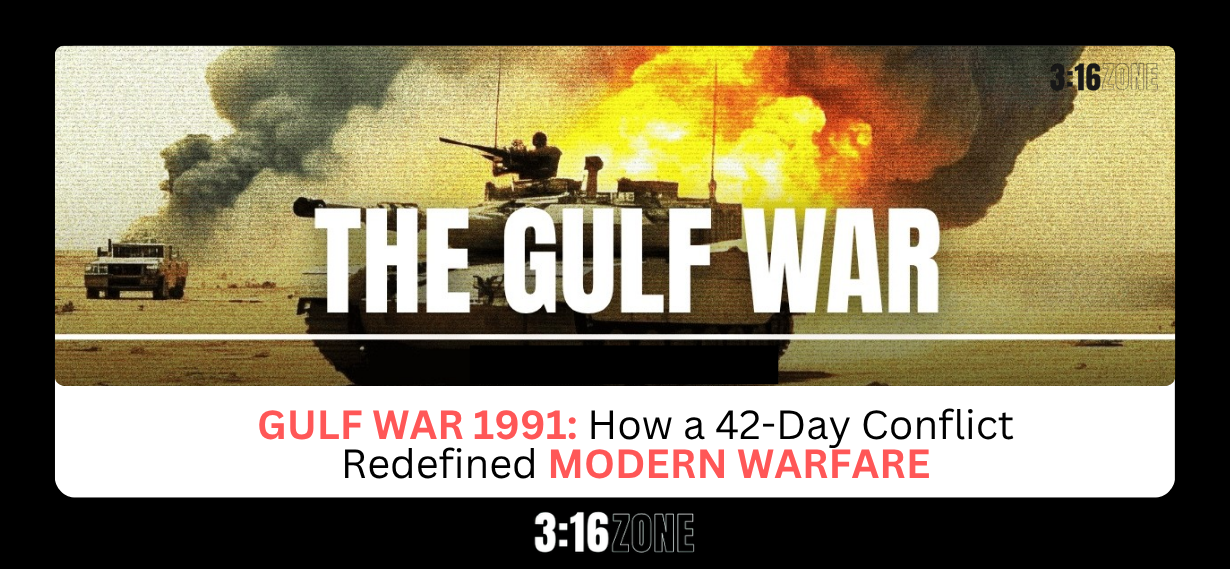
The Gulf War 1991 remains one of the most significant and technologically advanced conflicts of the late 20th century. Triggered by Iraq’s invasion of Kuwait in August 1990 under Saddam Hussein, the war rapidly escalated into an international crisis, involving a massive coalition led by the United States. This 42-day conflict not only liberated Kuwait but also reshaped military strategy worldwide.
Background: Iraq’s Invasion of Kuwait
In August 1990, Iraqi forces crossed into Kuwait, claiming economic disputes and territorial rights. The move provoked global condemnation, with the United Nations demanding immediate withdrawal.
The invasion threatened global oil supplies and regional stability, prompting the formation of a coalition of more than 30 countries, including Saudi Arabia, the United Kingdom, and France, under U.S. leadership.
Operation Desert Storm: The Air Assault That Changed Warfare
On January 17, 1991, coalition forces launched Operation Desert Storm, beginning with an intensive air campaign. Precision-guided missiles, stealth aircraft, and real-time intelligence allowed the coalition to strike key military targets while minimizing civilian casualties.
This operation marked a turning point in modern warfare, showcasing the power of high-tech weaponry and satellite-guided intelligence. Media coverage brought the conflict into homes worldwide, making it the first fully televised war.
The Ground Offensive: Swift and Decisive
Following weeks of aerial bombardment, coalition forces initiated a ground invasion in late February 1991, lasting only 100 hours. Iraqi troops were quickly overwhelmed, leading to a decisive victory and the liberation of Kuwait.
President George H. W. Bush highlighted the coalition’s effectiveness and the importance of international cooperation, as the operation minimized casualties compared to past large-scale wars.
Global Impact and Geopolitical Consequences
Although brief, the Gulf War had lasting effects:
- Iraq faced severe sanctions and international scrutiny while Saddam Hussein remained in power.
- Coalition warfare set a precedent for future military interventions, emphasizing the importance of alliances.
- Modern warfare techniques such as precision strikes, air superiority, and satellite intelligence became standard practice.
The war also influenced U.S. and global defense policies, particularly in Middle East geopolitics, and highlighted the strategic importance of rapid deployment forces.
Relevance Today
The lessons from the Gulf War 1991 continue to resonate in contemporary military strategy. Modern conflicts increasingly rely on coalition forces, advanced technology, and real-time intelligence—the hallmarks of the Desert Storm campaign. Understanding this war helps explain current U.S. and regional military policies.
Conclusion
The Gulf War 1991 was more than a short-lived conflict; it was a historic turning point that demonstrated the power of technology, coalition warfare, and rapid military action. While Kuwait was liberated, unresolved tensions in Iraq created a foundation for future conflicts, including the 2003 Iraq invasion. The war’s legacy continues to shape modern military strategy and geopolitical decisions worldwide.
FAQs
How long did the Gulf War last?
The main combat phase lasted approximately 42 days, with the ground war taking just 100 hours.
What was Operation Desert Storm?
It was the U.S.-led military campaign designed to liberate Kuwait, featuring high-tech air strikes and precision weaponry.
Which countries were part of the coalition?
Over 30 countries participated, including the United States, United Kingdom, France, and Saudi Arabia.
What were the outcomes of the Gulf War?
Kuwait was liberated, Iraq faced sanctions, and modern military strategies such as coalition warfare and precision strikes became more prominent.
Why is the Gulf War significant today?
It reshaped global military strategy, demonstrated the effectiveness of high-tech warfare, and influenced regional and international defense policies.